
Why Your Sales Team Isn't Selling (The 5 Hidden Reasons)
Updated: Jun 13
You hired a sales team so you could step back from chasing every lead yourself. But instead of more freedom, you've got a different kind of headache. The pipeline is stalling. Conversions are down. And every weekly meeting sounds the same, poor quality leads, busy schedules, timing wasn't right.
The frustrating part isn't the excuses. It's that you genuinely can't see why capable people are struggling to hit targets you used to hit on your own. Before you blame their work ethic or rewrite the commission structure, it's worth looking somewhere most business owners don't: the hidden friction points quietly making their jobs harder than they need to be.
Because here's the thing, even great salespeople struggle inside broken systems. And in most growing service businesses, the sales problem you're staring at didn't start in sales at all.

Is It Really a People Problem?
It might be. But before you land there, consider this: without a structured system behind them, salespeople spend up to 70% of their working day on admin, manual follow-ups, and inbox archaeology rather than actually talking to prospects. That's not a motivation problem. That's a workflow problem.
Your reps end up logging into three different systems just to piece together a customer's history. They write the same follow-up emails from scratch, copy data into spreadsheets, and toggle between WhatsApp threads and Outlook trying to figure out who needs a call next. By the time they've done all of that, their actual selling window has shrunk to a couple of rushed phone calls before five o'clock.
The High-Performing Reps Who Drowned in Paperwork
We did an audit for a growing commercial service provider in the UK who had brought in two experienced sales reps to drive regional revenue. On paper, these were strong hires. After three months, revenue hadn't moved. The owner was ready to let them go, assuming they were coasting on their base salaries.
We tracked their actual daily activity for a week. They weren't lazy, they were completely buried. Because the business had no central CRM or automated workflows, both reps were spending four hours a day manually formatting quotation documents, updating a shared tracking spreadsheet, and chasing internal staff for job pricing. They were being paid premium sales salaries to do low-level data entry. The moment we streamlined the tech stack and automated their document triggers, their call volume tripled. Revenue followed.
The problem was never the people. It was the system they were operating in.
If a Deal Isn't Visible, It Doesn't Exist
The Gut-Feel Trap
When you run a sales process out of spreadsheets, personal notebooks, or individual email inboxes, you force your team to operate on instinct. In your weekly catch-up, a rep tells you they've got a great feeling about a certain account, they're confident it'll close next week. What you can't see is that the quote has been sitting in their drafts for four days, or that the last actual interaction was an unanswered call a fortnight ago.
Salespeople are naturally optimistic. They gravitate toward the deals that feel close and exciting. The quieter opportunities, the ones that just need a simple, consistent follow-up, get overlooked. Not deliberately. Just because nothing in the system is pushing those deals to the front of the screen.
The Factory With No Conveyor Belt
Managing a sales force without an appropriate system is similar to managing a production floor with knowledgeable builders but no conveyor belt. Each employee must physically cross the floor to pass work to the next person, record their actions in a paper logbook, and go through a stack of boxes to determine what they need next.
It doesn't matter how talented those builders are. The output will be poor because the logistics are broken.
A well-configured CRM is the conveyor belt. It drops the next lead directly in front of your rep, gives them the context they need, provides the message template to send, and flags when something has stalled. Your job isn't to motivate people to run across the factory floor faster. It's to build the belt.
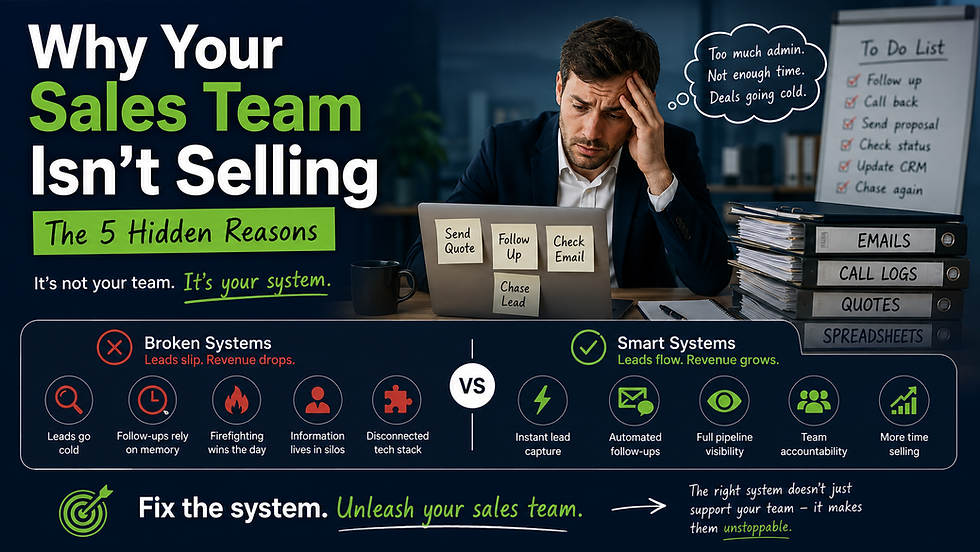
The 5 Hidden Reasons Your Sales Team Is Stalling
These aren't personality flaws. They're operational blind spots, and every one of them is fixable.
1. They're Playing Digital Detective
Your representatives are searching through old emails, private text messages, and scrawled notes to gather basic information about a prospect before they ever make a single call. Many of them won't make the call if they can't see a comprehensive, current picture of a customer's journey in one location. The friction of not knowing what was last said is enough to push it to tomorrow, and tomorrow never comes.
2. Follow-Up Depends Entirely on Motivation
Chasing a warm lead three, four, or five times is uncomfortable. Most salespeople quit after the first unanswered email and move on because they don't want to come across as pushy in the absence of automatic reminders and ready-to-send message templates that take the emotion out of the follow-up. The lead, who most likely just got busy, doesn't get back to you in the interim.
3. The Loudest Fire Wins the Day
New business is quiet. Account management issues are loud. And salespeople, like most humans, naturally gravitate toward what's urgent and emotionally pressing over what's disciplined and strategic. Without a system that keeps the new business pipeline front and centre, it gets pushed aside every single day by problems that feel more immediate, even when those problems are worth far less to the business.
4. Everything Lives in Personal Silos
When one of your reps is off sick or on leave, their entire pipeline effectively goes on holiday with them. If the team can't instantly step in, see the last communication, and pick up the conversation without the customer noticing a gap, it's not just an internal problem, it looks disorganised to the buyer. And buyers notice.
5. The Tech Stack Is a Disconnected Mess
One app for texts, another for email, a third for booking meetings, a fourth for tracking deals. It sounds manageable in theory. In practice, it creates what we call app fatigue, the slow, grinding frustration of switching between systems until your team quietly abandons the lot and goes back to pen and paper. The best system in the world is useless if nobody uses it.
Today's Deep Dive
What to Do Next
Your sales team doesn't need another motivational speech or a stern conversation about targets. They want a setting that makes it truly tough for them to fail, where the leads are in front of them, the follow-ups happen automatically, and the administrative tasks are taken care of so they can resume the tasks for which they were hired.
Start by being honest about where the friction is. Is it response time? Follow-up consistency? Visibility across the team? Information living in silos? Once you know what's actually broken, it's far easier to fix.
Schedule an appointment for a Clarity Call with us if you need a second opinion on your present setup. We'll go through your pipeline together, find where the gaps are, and give you a straight answer about what needs to change, and how quickly it can.
The goal isn't to manage your team harder. It's to build a process that makes selling feel inevitable.
Or have a read of our related blog: 'Waggle Dance CRM vs Capsule CRM, Which One Is Actually Built for Growing UK Service Businesses?'
FAQs
How do I know if my sales team is lazy or just disorganised?
Take a look at how they truly spend their time. They are victims of a flawed process rather than being lazy if they are spending hours formatting documents, updating spreadsheets, or going through old emails. A lazy team avoids calls even when the system makes it easy. A disorganised team wants to make calls but keeps running out of time before they get there.
Will automating follow-ups make us look robotic to prospects?
Not if it's done correctly. Automation should ensure that real discussions take place at the appropriate time, not replace them. Three days after submitting a quote, a straightforward text message stating, "Hello Mark, just ensuring the pricing landed okay? appears professional and responsive. The prospect has no idea it was automated. They just think you're organised.
How does a CRM actually help with accountability?
It brings sales out of the shadows and into the open. You get a clear dashboard that shows how many contacts were made, how long quotations are sitting undisturbed, and precisely where deals are dropping out, rather than depending on gut-feel updates during your weekly meeting. You begin managing statistics instead of emotions. It's much simpler to have that conversation.
We track everything on a spreadsheet. Why isn't that working?
Because spreadsheets are completely passive. They don't send reminders. They don't track whether a prospect opened your email. They don't centralise conversation histories or flag deals going cold. A spreadsheet tells you what went wrong after it's happened. A proper sales system works to stop things going wrong in the first place.
What's the fastest way to get a sales team to actually adopt a new system?
Make their lives easier on day one. If the new tool cuts their admin, automates the boring stuff, and helps them close more deals with less effort, they won't resist it, they'll protect it. Resistance to new systems almost always comes from tools that add work rather than remove it. Get that right and adoption takes care of itself.


